
What is an electronic signature?
The short answer and the long one — what counts as an e-signature, how the technology works, the legal tiers, and where it does (and doesn't) hold up.
An electronic signature is any electronic indication that a person agrees to the contents of a document. It can be a name typed into a box, a signature drawn with a finger or stylus, or a click on an “I agree” button — as long as it is logically associated with the record and captured with the intent to sign.
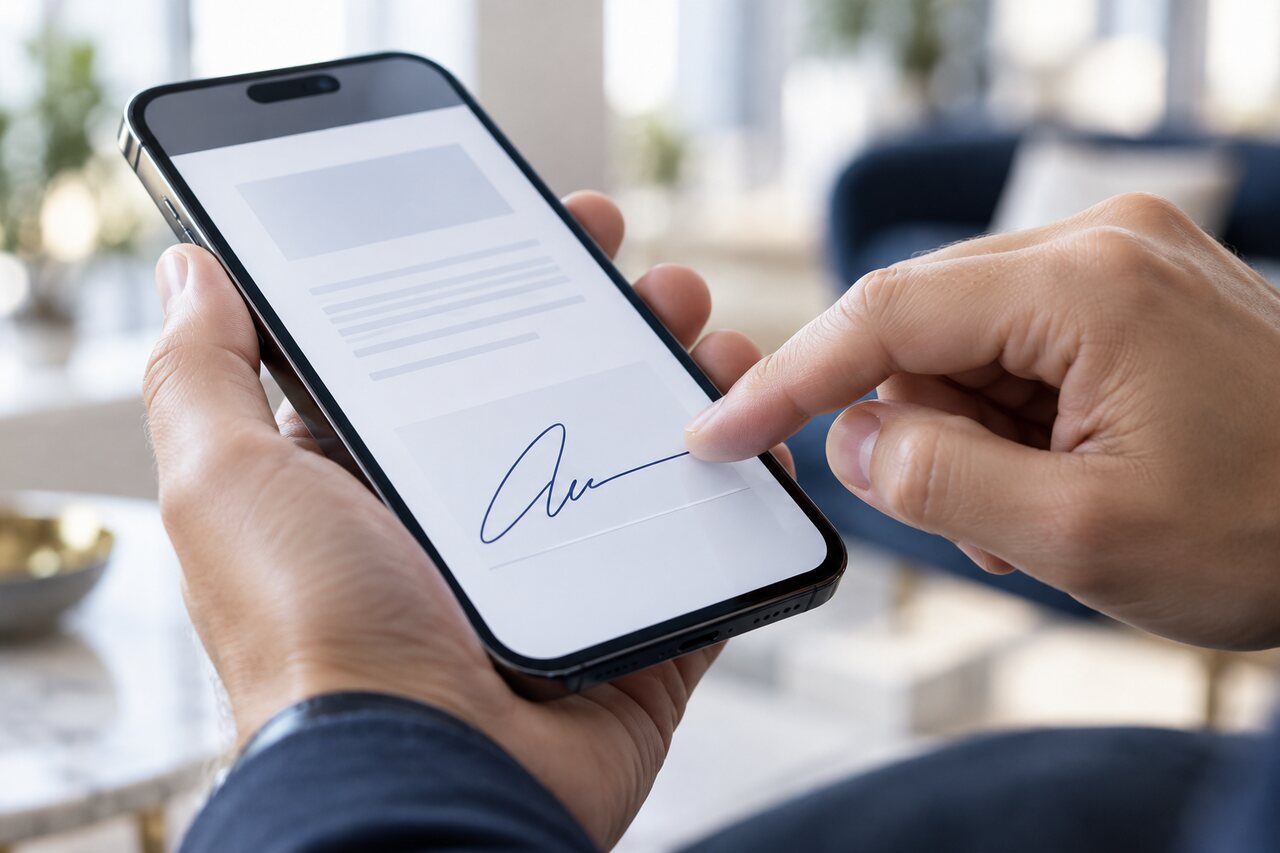
A plain definition
Legally, most frameworks define an electronic signature broadly. The US ESIGN Act calls it “an electronic sound, symbol, or process attached to or logically associated with a contract or other record and executed or adopted by a person with the intent to sign the record.” In practice that covers a wide range of actions:
- Typing your name at the bottom of an online form
- Drawing a signature on a touchscreen
- Clicking “Accept” on terms of service
- Applying a saved signature image inside a signing platform
- Replying “I agree” to a contract by email, in some contexts
What turns any of these into a valid signature is not the shape of the mark but the surrounding evidence: that the right person did it, meant to do it, and that the signed document hasn't changed since. That evidence is exactly what dedicated e-signature services are built to capture.
Electronic signature vs digital signature
These two terms are used interchangeably in everyday speech, but they are not the same thing — and the difference occasionally matters.
| Electronic signature | Digital signature |
|---|---|
| A broad legal concept | A specific technology |
| Any electronic mark showing intent | Uses PKI cryptography + a certificate |
| Captures intent to sign | Verifies identity & detects tampering |
| Example: typed name, drawn mark, “I agree” | Example: a certificate-based seal on a PDF |
The clean way to remember it: every digital signature is an electronic signature, but not every electronic signature is a digital signature. A digital signature is the cryptographic engine that some electronic signatures use under the hood to prove who signed and that nothing was altered afterwards. For high-value contracts, regulated industries and anything litigation-sensitive, that cryptographic layer is worth having.
The three legal tiers: SES, AES and QES
Under the EU's eIDAS regulation — and increasingly as a mental model everywhere — electronic signatures come in three levels of assurance:
Simple Electronic Signature (SES)
The basic tier: a typed name, a drawn mark, a checkbox. Easy and valid for most everyday agreements, but it carries the least built-in proof of identity.
Advanced Electronic Signature (AES)
Uniquely linked to the signer, capable of identifying them, created with data under their sole control, and tied to the document so tampering is detectable. This is where cryptography (a digital signature) typically comes in.
Qualified Electronic Signature (QES)
An AES created with a qualified signature-creation device and backed by a qualified certificate from a trust service provider. In the EU, a QES carries the same legal effect as a handwritten signature by default and is the highest tier.
Which tier do you need? For the overwhelming majority of business and personal documents, a simple or advanced electronic signature is enough. Qualified signatures matter mainly for specific regulated or high-stakes situations in the EU.
How the signing process works
Behind the friendly interface, a reputable e-signature service does several things each time a document is signed:
- Prepares the document. The sender uploads a file and places fields — signature, initials, date, text — for each party.
- Verifies the signer. The signer is identified to some degree: by email access at minimum, and optionally by SMS codes, ID checks or knowledge-based questions.
- Captures intent. The signer reviews the document and actively applies their signature, confirming they mean to be bound.
- Seals the record. The completed file is cryptographically sealed so any later change becomes detectable.
- Produces an audit trail. A certificate of completion records who signed, when, from which device and IP, and in what order — the evidence that makes the signature defensible.
That audit trail is the quiet superpower of electronic signing. A scanned wet-ink contract tells you little about how it was signed; an e-signed record comes with a timestamped history attached.
Is it legal? ESIGN, UETA & eIDAS
Yes — in most of the world, and for most documents. Three frameworks do the heavy lifting:
- ESIGN Act (US, 2000) — a federal law making electronic signatures and records legally valid and enforceable in interstate and foreign commerce.
- UETA (US, 1999) — a model state law adopted by 49 states plus D.C., giving electronic records and signatures the same standing as paper within a state.
- eIDAS (EU, Regulation 910/2014) — governs electronic identification and trust services across the EU, recognising the SES / AES / QES tiers above.
Many other jurisdictions — the UK, Canada, Australia, India, Singapore and more — have equivalent laws. For an electronic signature to be enforceable, the common threads are: the signer intended to sign, they consented to doing business electronically, the signature is associated with the record, and the record is retained and reproducible.
Documents that may still need ink
A short list of document types is often excluded or needs special handling. Exact rules vary by jurisdiction, but commonly include:
- Wills, codicils and testamentary trusts
- Certain family-law documents (e.g. adoption, divorce in some places)
- Some property transfers and real-estate deeds
- Court orders and official notices in some jurisdictions
- Documents requiring notarisation or a witnessed wet-ink signature
When a document could fall into one of these categories, check local law or ask a qualified lawyer before signing electronically.
Why people use them
The appeal is practical. Electronic signatures turn a multi-day paper chase into a few minutes of clicking, and they leave a cleaner record than paper ever did:
- Speed — agreements close in minutes, not postal days.
- Cost — no printing, scanning, couriers or physical archiving.
- Accuracy — required fields can't be skipped; pages can't go missing.
- Evidence — a tamper-evident audit trail accompanies every file.
- Reach — parties sign from anywhere, on any device.
The pitfalls to know
Electronic signing is not risk-free, and a good resource says so. The main things to keep in mind:
- Identity is only as strong as your authentication. An emailed link alone proves access to an inbox, not that the right human signed. Enable stronger verification for anything important.
- Phishing imitates signing requests. Fake “please sign” emails are a common attack. Always verify the sender and log in directly.
- Not every document qualifies. See the exclusions above.
- Vendor lock-in and limits. Per-envelope caps and proprietary formats can create cost and portability issues at scale.
- Record-keeping is on you. You need to be able to retain and reproduce signed records — don't rely solely on a free account you might lose.
Signing online soon? Spend a few minutes on the safety basics first — it's the single best way to avoid the common mistakes. Read the security & safety guide →
Now compare the tools
See how popular e-signature services stack up on pricing, features and compliance — no verdicts, just the facts.
Explore the service guide